


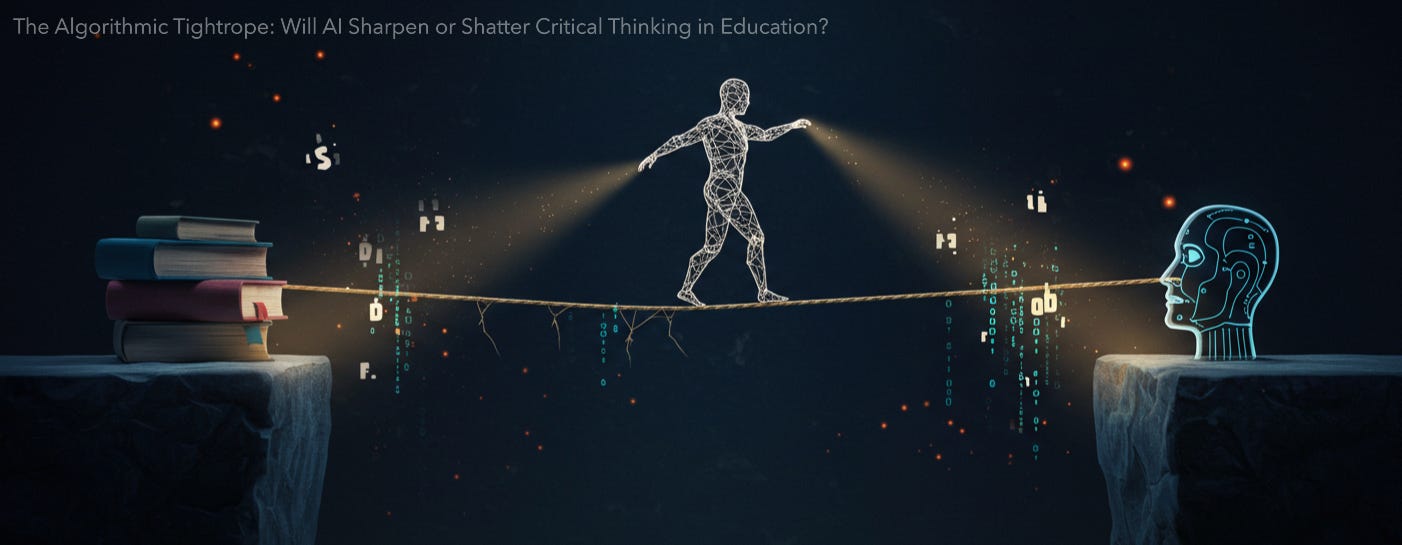
The rapid integration of generative AI tools like ChatGPT, Claude, and Gemini into the academic landscape has ignited a fierce debate. Reports and articles suggest many students are leveraging these tools for tasks like brainstorming ideas and drafting essays. This technological wave crashes directly against the bedrock of education: the cultivation of critical thinking. But is AI a tool destined to enhance our analytical capabilities, or is it a seductive shortcut leading to intellectual atrophy? The answer, it seems, is complex and hinges on how we navigate this new terrain.
Critical thinking, at its core, involves the ability to analyze information objectively, identify underlying assumptions and biases, make reasoned judgments, solve complex problems, and engage in reflective thought. Human reasoning. It's the engine of innovation, informed citizenship, and personal growth. Therefore, the central question isn't just whether AI impacts this crucial skill, but how. This post explores the shifts in higher education, unique considerations for K-12, pressing concerns, potential solutions, and societal risks, aiming to understand how to foster resilient critical thinking. These are my collected thoughts and may evolve.
AI in Higher Education: A Critical Thinking Crisis or Cognitive Evolution?
The presence of generative AI higher education is undeniable. Students readily employ these tools to summarize dense academic papers, generate code, refine prose, and even outline arguments. Faculty members may be observing a changing landscape in student submissions; some work appears polished, yet lacks the depth, original analysis, or nuanced argumentation expected at higher levels. This poses a significant challenge to traditional assessment methods, as standard essays and take-home exams become increasingly vulnerable to AI assistance, prompting a necessary re-evaluation of how we measure genuine understanding and skill application. One potential avenue for addressing this challenge is the use of AI itself. Could we leverage AI to detect AI, creating a technological arms race in education? Has it already started?
Central to the central question is whether relying on AI is actually weakening students' critical thinking skills. One side argues that "cognitive offloading" – outsourcing analysis and evaluation to algorithms – breeds intellectual passivity and makes it harder to distinguish AI-generated falsehoods from real information. However, others believe AI can free up students' minds for higher-level tasks, such as critiquing AI results or tackling complex problems. New skills, like prompt engineering and evaluating AI's output, are also emerging, demanding careful analysis. Right now, most of the evidence is uncertain. While studies are starting to appear, we need longer-term research to fully understand AI's impact on student learning.
It's crucial for educators and institutions to watch for signs that AI might be hindering critical thinking. Red flags include: students struggling to develop original arguments or ask insightful questions; difficulty judging the reliability of sources, especially AI-generated content; a reluctance to persevere through challenging problems, turning to AI too quickly; and a concerning similarity in ideas and writing styles across assignments. Declining performance on tasks requiring independent analysis, like seminar discussions, lab work, or traditional exams, could also indicate an unhealthy reliance on AI.
AI in K-12: Laying the Foundation or Undermining It?
AI is increasingly present in K-12 education, appearing in adaptive learning programs, research tools, and coding resources. While personalized learning is attractive, introducing these tools to young learners requires caution, as their core thinking skills are still developing. We must carefully consider how AI impacts critical thinking in K-12, balancing technology with essential learning.
The biggest worry is the potential impact on cognitive development. Many fear that early AI reliance could hinder the natural development of analytical, reasoning, and problem-solving skills. If students passively accept AI-generated answers instead of actively learning to find solutions, question information, and form arguments, we risk undermining their critical thinking foundations. This impacts not just academics but also intellectual curiosity and resilience.
Furthermore, AI in K-12 raises significant equity issues. Unequal access to AI or, more importantly, quality instruction on its ethical and effective use, could widen existing achievement gaps. Young students also struggle to understand algorithmic bias, digital privacy, and plagiarism when using AI. If AI becomes the primary answer source instead of a tool used thoughtfully alongside traditional methods, we risk creating learners who aren't self-sufficient or critical.
Navigating the AI Revolution: Solutions and Strategies for Education
Addressing the challenges of AI requires more than just updated policies. A fundamental shift in how educators teach and assess may be needed. It might be beneficial to move away from focusing solely on the final product, which AI can easily mimic, and instead emphasize the learning and thinking process. This could include assignments like annotated bibliographies detailing research strategies, reflective essays on the learning journey, tracked changes showing drafting and revision, and engaging in-class activities like debates, seminars, presentations, and real-world projects that demand collaborative problem-solving. Assessments could constructively use AI by asking students to critique AI-generated essays, compare different AI models, or use AI for brainstorming before developing their own unique ideas.
Ideally, AI literacy programs should be developed at all levels of education. Students could benefit from learning how AI models work, including their limitations, potential biases, and ethical implications. Prompt engineering might be taught as a critical thinking exercise, demanding clarity and precision. Institutions could establish clear guidelines on responsible AI use, moving beyond simple bans to thoughtful integration. Ideally, digital citizenship and AI ethics should be woven throughout the curriculum, not just taught as isolated topics.
Fostering metacognition – the ability to think about thinking – could prove highly valuable. Educators might encourage students to reflect on their learning process, their reasons for using (or not using) AI, and how it affects their understanding. Teaching students to self-assess their knowledge and consciously choose when AI is truly helpful versus when independent thought is needed may be useful. This self-awareness could help ensure students remain in control of their learning, using AI as a tool, not becoming dependent on it."
Beyond the Ivory Tower and Schoolyard: Societal Risks of Diminished Critical Thinking
A possible decline in critical thinking skills, perhaps accelerated by the uncritical use of AI, might extend far beyond academic consequences. There could be significant societal risks if AI education practices fail to adapt. Should a populace's ability to analyze information, discern fact from fiction, and evaluate arguments critically erode, society could become more vulnerable to misinformation, disinformation, and manipulation – phenomena that AI itself might unfortunately amplify. Perhaps an informed and discerning population is the bedrock of functional democracy, and its foundation is threatened if critical thinking wanes.
The future workforce may increasingly demand adaptability, creativity, complex problem-solving, and nuanced critical evaluation – precisely the skills that could be undermined by passive reliance on AI. While proficiency in using AI tools will undoubtedly become essential, failing to think critically beyond what AI can generate may be a severe disadvantage. Furthermore, the uncritical acceptance and deployment of AI systems trained on biased data might perpetuate and even scale existing societal inequalities. Perhaps critical human oversight and evaluation are necessary to avoid automating prejudice.
It seems true innovation rarely springs from simply re-combining existing information, which is largely what current generative AI models excel at, given they are trained on vast amounts of historical data. Breakthroughs often require deep, original thought, challenging established assumptions, and the kind of non-linear, creative thinking that emerges from sustained intellectual effort. Becoming overly reliant on AI's synthesis of the known – and therefore, potentially limited by the patterns and biases within that historical data – could stifle the very sparks of curiosity and critical inquiry that drive human progress. Perhaps preserving and nurturing our capacity for independent, critical thought is not just an educational goal; it's a societal imperative.
Conclusion: Cultivating Human Intellect in the Age of Algorithms
Artificial intelligence presents education with a profound paradox: it offers the potential to revolutionize learning and augment human intellect, yet simultaneously carries the risk of fostering dependency and eroding the critical thinking skills essential for navigating an increasingly complex world. This debate reveals that the outcome is not predetermined; it depends on the choices we make now as educators, students, policymakers, and citizens. Ignoring the challenge or rejecting powerful tools is simply not an option.
Moving forward requires proactive and thoughtful adaptation. As we move forward, it might be worth shifting a shift toward a shift in focus is needed—one that values the process of inquiry, fosters AI literacy and ethical understanding, and champions metacognitive awareness. The goal isn't to "AI-proof" education, but to integrate these tools in ways that enhance human cognition. Perhaps students should learn to think with, about, and critically beyond AI.
Achieving this requires a concerted effort. Educators might embrace pedagogical innovation and commit to teaching critical AI literacy. Students could engage with AI responsibly, prioritizing genuine understanding over superficial shortcuts and rigorously questioning AI outputs. And institutions and policymakers could bear the responsibility of providing resources, training, and clear, adaptable guidelines, while supporting research into the long-term cognitive effects of AI integration. Perhaps, in an era increasingly shaped by algorithms, cultivating robust, independent human critical thinking remains our most vital task and our most valuable asset.
The future isn't a fixed destination; it's a journey we're creating together—and the direction we take is our responsibility. While uncertainty is inherent, we can still shape that journey by making conscious choices, embracing innovation, and remaining open to new possibilities, wielding our power to make a difference, even without knowing exactly what lies ahead.
-db