


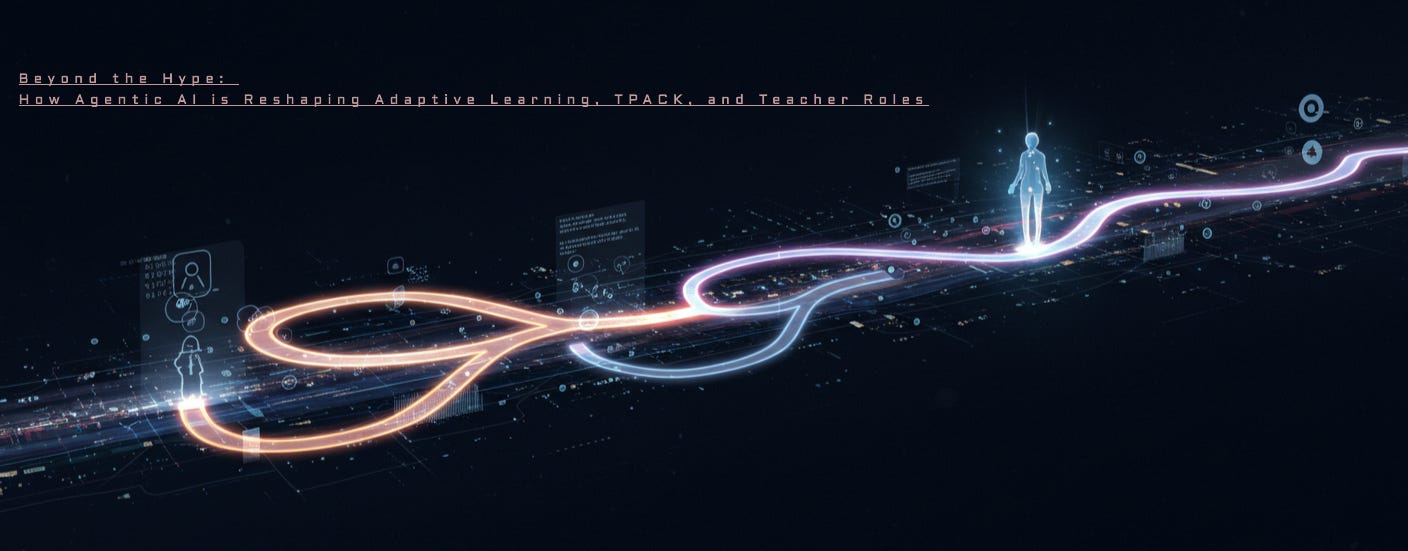
The sheer volume of tasks facing educators today can feel overwhelming. From crafting differentiated lessons for diverse learners to managing administrative duties and providing meaningful feedback, the demands are immense. Now, whispers and sometimes shouts about Artificial Intelligence entering the classroom add another layer – excitement for some, apprehension for others. But the latest wave, Agentic AI, represents a significant shift, moving beyond simple tools towards potentially proactive partners in education.
So, what exactly is Agentic AI? Unlike familiar AI tools like grammar checkers or basic chatbots that react to specific commands, agentic AI systems possess a degree of autonomy. They can understand goals, make plans, and execute multi-step tasks proactively to achieve those goals within set boundaries. Think less of a calculator and more of a highly efficient, data-savvy assistant capable of independent operation on defined tasks. In my opinion, understanding this distinction is crucial because the true promise of Agentic AI in Education isn't about replacing the irreplaceable human element of teaching; it's about augmenting educators, freeing them to focus on the uniquely human aspects of their role – mentorship, fostering creativity, and deep socio-emotional support.
This piece will explore the potential impact of agentic AI on critical areas: transforming educational workflows, revolutionizing AI adaptive learning by leveraging a learner's entire learning history, rethinking the TPACK framework for educators, and considering the role of advanced interfaces like AI avatars and the quest for emotional connection. Ultimately, we'll argue that the most effective integration places human educators firmly at the helm, enhanced, not sidelined, by these powerful new tools.
What is Agentic AI and Why Does it Matter for Education?
Delving deeper, agentic AI systems are designed not just to respond, but to anticipate and act. They can learn from interactions, potentially coordinate with other AI agents, and manage complex processes from start to finish. Imagine an AI agent tasked with supporting a student struggling with a specific physics concept. Based on the goal of 'improve understanding of Newtonian mechanics', the agent could analyze the student's past performance (across all relevant subjects), identify specific knowledge gaps, proactively source relevant videos, articles, and practice problems tailored to their learning style, schedule focused micro-learning sessions, and even design a mini-project to apply the concepts – all while keeping the teacher informed.
This proactive capability leads to compelling, albeit sometimes hypothetical or emerging, examples in the educational context. Consider an AI agent monitoring online class discussions, not just for keywords, but for underlying confusion or common misconceptions among students, then drafting concise clarification notes or suggesting discussion prompts for the teacher to review and deploy. Another example is an AI agent managing the logistics of differentiated instruction, automatically adjusting the flow and type of digital resources delivered to individual students or small groups based not just on their last quiz score, but on a holistic view of their engagement, progress across related skills tracked over their entire learning history, and even their stated interests. The key difference here, based on current trends and research described by AI labs and EdTech analysts, is the shift from reactive educational tools to proactive AI teacher assistant partners, capable of handling sophisticated, multi-step AI educational workflows.
Transforming Educational Workflows: Giving Time Back to Teachers
It's no secret that educators are burdened by time-consuming administrative tasks that detract from direct student interaction. Data consistently highlights the significant hours spent on lesson planning, grading, reporting, and communication – tasks essential for organization but often draining on the energy needed for mentorship and personalized instruction. This is where, I believe, agentic AI offers one of its most immediate and tangible benefits: streamlining and automating these workflows.
Imagine agentic systems taking on the initial heavy lifting of AI curriculum development support: generating first drafts of differentiated lesson plans based on curriculum standards and student profiles, curating relevant open educational resources (OERs) aligned with specific learning objectives, or even handling routine scheduling and communication tasks, like sending reminders or answering frequently asked questions from parents and students (always with teacher oversight). In assessment, an agent could provide initial feedback on structured assignments (like coding exercises or grammar tasks), identify patterns of errors across a class to inform the teacher's instruction, or continuously monitor student progress against learning goals, flagging individuals who might need targeted human intervention.
The objective consequence of this automation, as suggested by proponents of AI Teacher Augmentation, is profound: freeing up significant chunks of educator time. This recovered time isn't for idleness; it's repurposed for the high-impact activities that AI cannot replicate: engaging in deep pedagogical discussions, providing nuanced, empathetic feedback, coaching students through complex problems, fostering collaboration and creativity in the classroom, and building the strong interpersonal relationships that are foundational to effective learning. The goal is using AI to reduce teacher workload so teachers can focus on teaching and connecting.
Agentic AI & Adaptive Learning: Towards True Personalization at Scale
Current adaptive learning platforms have already made strides in personalization, often using rule-based systems to adjust content difficulty based on recent performance. However, Agentic AI promises a quantum leap towards truly dynamic and holistic personalized learning AI. The defining characteristic is its potential ability to process and synthesize vastly more data, crucially including the entire learning history of an individual.
This means moving beyond isolated data points like test scores. An agentic system could potentially factor in a student's past project successes and failures, their performance in related subjects, their engagement patterns with different types of content, their self-reported interests, feedback from previous teachers, and perhaps even (with explicit consent and strong privacy safeguards) data from informal learning experiences. This comprehensive understanding allows for the creation of learning pathways that are not just adaptive, but deeply personalized and dynamically adjusted in real-time. If a student excels in a math concept, the agent might proactively suggest a challenging cross-curricular project connecting it to science or art, leveraging AI to connect different school subjects based on that student's unique profile.
The vision, based on the trajectory of AI adaptive learning development, is one where learning journeys become incredibly responsive and interwoven. An agentic AI could identify that a student struggling with historical analysis might benefit from revisiting specific reading comprehension skills learned in a language arts class two years prior, seamlessly integrating that practice. It could notice a burgeoning interest in coding and suggest relevant pathways long before a formal computer science class begins. This represents a shift towards a more organic, interconnected, and learner-centered educational experience, guided by AI insights but ultimately curated and validated by human educators.
Rethinking TPACK: Educator Skills in the Age of Intelligent Agents
The established TPACK (Technological, Pedagogical, and Content Knowledge) framework provides a valuable lens for understanding effective technology integration in teaching. The rise of agentic AI necessitates, in my view, a significant evolution in how we conceptualize and develop these knowledge domains for educators undergoing TPACK AI Integration.
Technology Knowledge (TK) will expand beyond operating specific software to understanding the capabilities, limitations, ethical implications, and optimal prompting techniques for interacting with intelligent agents. Pedagogical Knowledge (PK) becomes even more critical; educators will need the wisdom to discern when and how to strategically deploy agentic tools to support learning goals, designing activities that leverage AI for foundational tasks while focusing human instruction on higher-order thinking, critical analysis, and collaborative problem-solving. Content Knowledge (CK) remains paramount, not just for direct instruction, but also for evaluating and guiding the outputs of AI, ensuring the accuracy and appropriateness of AI-suggested content connections and learning pathways. Subject matter expertise is vital to validate the AI's work.
Furthermore, new competencies emerge as essential. AI literacy – a fundamental understanding of how AI works, its potential biases, and its societal impact – becomes a core requirement. Educators will need skills in data-informed instruction, interpreting the insights provided by AI systems to make pedagogical decisions. Crucially, proficiency in managing the AI-human collaboration in the classroom, fostering a learning environment where technology augments rather than dictates, will be key. Preparing educators for this shift requires deliberate effort in professional development and a rethinking of teacher training programs.
Emotional Connection, Avatars, and Holistic Development: The Human-Tech Interface
The integration of advanced technologies like sophisticated AI avatars introduces another dimension to the discussion, particularly concerning student engagement and support. These avatars, powered by agentic AI, could potentially serve as tireless learning companions for drill-and-practice, patient tutors offering Socratic dialogue, or low-stakes practice partners for presentations or language skills. The concept of Intelligent Tutoring Systems evolves with these more interactive and potentially responsive interfaces.
Some research explores the potential for "emotional AI" – systems designed to recognize cues related to student engagement, frustration, or confusion. This is an area, however, that I believe requires extreme caution and stringent ethical oversight. While such data might offer educators additional insights into a student's state, it's crucial to emphasize that AI cannot replicate genuine human empathy, understanding, or nuanced socio-emotional support. Any attempt at Emotional AI Education Ethics must draw clear boundaries, ensuring such features serve primarily as indicators for the human educator, rather than attempting to replace human connection. AI's role here, if any, should be strictly supportive and transparent.
Ultimately, fostering holistic student development, including crucial socio-emotional learning (SEL), remains a fundamentally human endeavor. While agentic AI, by analyzing the entire learning history and suggesting interconnected curriculum links, might help educators see a more complete picture of the learner, it's the teacher who guides SEL, navigates complex social dynamics, and nurtures well-rounded individuals. The technology can provide data points, but the interpretation, empathy, and guidance must come from a human.
The Unshakable Imperative: Augmentation, Not Replacement
Let's state this unequivocally: The primary, ethical, and most effective goal of integrating agentic AI into education should be AI Teacher Augmentation, not teacher replacement. This isn't just a hopeful sentiment; in my opinion, it's a practical necessity grounded in the distinct strengths of both AI and human educators. Failing to recognize this leads down a path detrimental to true learning.
AI excels at processing vast amounts of data, identifying patterns invisible to the human eye, automating complex but routine AI educational workflows, delivering personalized content consistently and at scale, and offering tireless availability for certain types of queries or practice. These are powerful capabilities that can undoubtedly enhance efficiency and personalization in ways previously unimaginable.
However, the core of education lies in uniquely human capabilities that AI, in its current and foreseeable forms, cannot replicate. These include building genuine rapport and trust through mentorship, providing nuanced socio-emotional support based on deep contextual understanding, fostering creativity and divergent thinking, guiding ethical development and navigating moral ambiguity, inspiring passion and intrinsic motivation, and adapting with empathy and wisdom to the unique, often unpredictable, needs of individual learners. These are the cornerstones of impactful teaching. The synergy lies in augmenting human teachers with AI tools, allowing AI to handle the automatable tasks while freeing humans to double down on connection, inspiration, and higher-order cognitive and emotional development.
Navigating the Challenges: Ethical Considerations and Practical Hurdles
While the potential of agentic AI is exciting, realizing its benefits requires navigating significant challenges and ethical considerations head-on. We must proceed with caution and critical awareness. Key among these hurdles is data privacy and security. As AI systems leverage the entire learning history, questions about data ownership, consent, protection against breaches, and potential misuse become paramount. Robust safeguards and transparent policies are non-negotiable.
Furthermore, the risk of algorithmic bias is ever-present. AI systems trained on biased data can perpetuate and even amplify existing societal inequities. Ensuring fairness, equity, and cultural responsiveness in AI tools requires rigorous testing, ongoing auditing, and diverse development teams. The digital divide also looms large; equitable access to the necessary hardware, software, and high-speed internet is essential to prevent these advanced tools from exacerbating existing gaps between well-resourced and under-resourced schools and students.
Practical hurdles include the significant implementation costs and the need for adequate technological infrastructure. Perhaps most critically, comprehensive teacher training and ongoing professional development are essential to equip educators with the skills and confidence needed for effective TPACK AI integration. We must also guard against over-reliance on AI, which could potentially lead to the deskilling of educators in certain areas, and establish clear ethical guidelines for the use of potentially sensitive technologies like AI avatars education and emotional AI, ensuring they support, rather than undermine, student well-being and autonomy.
Conclusion: Embracing an Agentic Future, Led by Humans
Agentic AI stands poised to significantly reshape the educational landscape. Its potential to streamline AI educational workflows, power deeply personalized learning AI through analysis of the entire learning history, create interconnected curriculum experiences, and refine AI adaptive learning is undeniable. These advancements offer the tantalizing prospect of a more efficient, responsive, and individualized learning environment for every student.
However, the narrative must remain firmly centered on AI Teacher Augmentation. Technology, no matter how intelligent, should serve pedagogy and enhance human connection, not supplant them. The irreplaceable value of a skilled, empathetic, and inspiring educator remains the bedrock of meaningful education. Agentic AI can be a powerful tool in their hands, freeing them from administrative burdens and providing data-driven insights, but it cannot replicate the mentorship, socio-emotional guidance, and creative spark that define great teaching.
Embracing this future requires a mindset of thoughtful exploration, critical evaluation, and a commitment to responsible implementation. It demands ongoing dialogue about ethics, equity, and efficacy. Most importantly, it requires prioritizing investment in our educators, equipping them with the knowledge (evolving TPACK) and support needed to lead the way in this new era, ensuring that technology empowers teaching and deepens learning for all.
An extensive, thoughtful and thought-provoking consideration of the complementary role agentic AI could play in supporting optimized student learning experiences.